

What is a tummy tuck? – by Brad Denney, M.D.
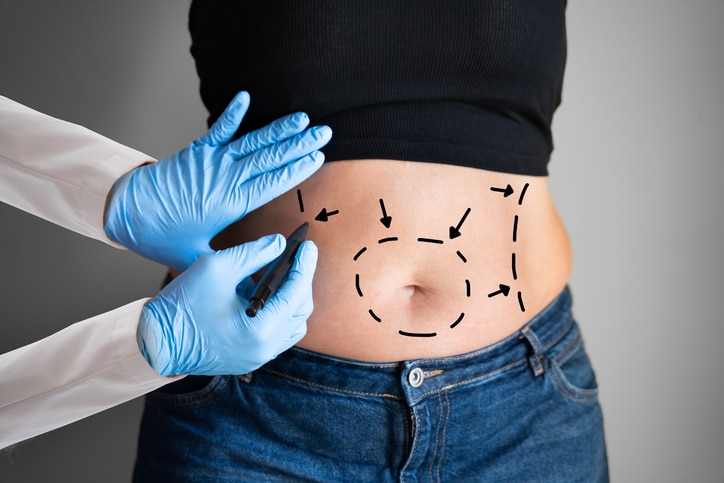
A “tummy tuck,” also called abdominoplasty, is a cosmetic surgery to tighten the abdomen (stomach) and sides. Tummy tucks accomplish three main objectives: manage excess skin, contour excess fat, and tighten the abdominal muscles.
Mini vs. full abdominoplasty
Tummy tucks are classified as “mini” or “full” abdominoplasty based on the length of the incision (cut) needed. If more tissue must be removed, then a longer incision is required. For a small amount of excess skin and fat below the belly button, a mini abdominoplasty may be performed. The incision is made in the middle third of the abdomen along the bikini line.
A full abdominoplasty is for moderate to larger amounts of excess skin and fat above and below the belly button. The incision usually runs the entire length of the bikini line and around the belly button itself.
Who benefits from a tummy tuck?
Patients who typically benefit from a tummy tuck seek an improvement in abdominal contour and waistline size and want their clothing to fit better. For example, they may have noticed changes in their abdominal contour after pregnancy that did not improve with exercise alone. This is usually due to a condition called rectus diastasis, or widening of the abdominal muscles, which is caused by pressure on the abdominal wall during pregnancy.
Procedure and recovery
The surgery itself takes about three hours, and most patients return home the same day. Most surgeons leave a drain under the skin that is removed after a few days. Patients often feel the need to walk “hunched over” for a few days due to the tightening of the abdomen.
Liposuction (a fat removal procedure) is often used as part of a tummy tuck, especially on the sides of the abdomen. Bruising and swelling are common in those areas for several weeks. Typically, tummy tuck scars are hidden below the bikini line. Most surgical incisions will fully heal in 6-8 weeks.
The most serious possible complication with this procedure is deep vein thrombosis (DVT), a blood clot in the legs, which in rare cases can lead to a pulmonary thromboembolism (PTE), a blood clot in the lungs. In the lungs, blood clots can potentially be fatal. Surgeons stress the importance of getting up and walking soon after surgery, to help prevent blood clots from developing.
For more information and to schedule a consultation, please call our office at 205-871-4440.