

Brachioplasty and improvement in upper arms
Patients sometimes come to us when they are bothered by the loose appearance of their upper arms, which they often notice most in sleeveless shirts. There are two surgical options for aesthetic improvement in the upper arms, brachioplasty and liposuction, which are often combined. The approach or approaches used depend on the amount of skin laxity (loss of firmness and elasticity) and excess fat.
Brachioplasty requires an incision (a cut, which causes a scar) to remove the excess skin. The scar location and length vary depending on several factors, including the amount of lax skin. If excess skin and fat are both present, liposuction may be needed along with brachioplasty.
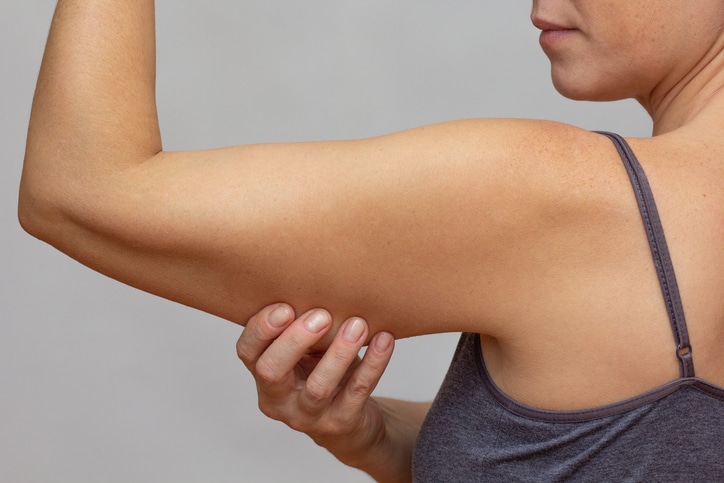
The picture above shows moderate skin laxity in the first one-third of the arm with minimal excess fat. This patient would be a good candidate for brachioplasty with a limited, T-shaped scar within the armpit.
Who is not a candidate for brachioplasty?
Some patients are not good candidates for the procedure, due to risk factors such as:
- Neurological or vascular disorders of the upper extremities
- Lymphedema of the arms
- Collagen vascular disorders (such as Ehlers-Danlos syndrome)
- Heart disease
- Uncontrolled diabetes
- History of keloids or hypertrophic scars
Your weight should be stable for 6-12 months prior to surgery, and it is preferred that you are not expecting any additional pregnancies. You must be nicotine-free for at least one month prior to surgery.
What are the potential complications of brachioplasty?
The brachioplasty scar is likely the most noticeable scar in plastic surgery, and it will be visible depending on clothing coverage. The procedure trades a more pleasing contour of the arm for a scar. The scar may stay thick and heavy for a prolonged period, but its appearance will continue to change during the first year.
Surveys of plastic surgeons and the public suggest that a scar on the inner arm is preferred to a scar on the back of the arm. The scar on the inner arm is less visible. However, the skin is thinner here, so the scar may become wider. The scar on the back of the arm can be thinner because of better skin quality, but it is more visible.
Other potential complications include reopening of the incision, fluid buildup under the skin (seroma), infection, numbness, and recurrent skin laxity.
What can I expect after surgery?
Your surgeon places a drain near your procedure site, and it remains for several days. The arms are wrapped for two days, then this wrapping is removed by your surgeon. For at least two weeks, patients are encouraged to wear snug clothing such as long-sleeve activewear shirts for compression. Patients should avoid raising their arms above the shoulders during those two weeks. Afterward, they can begin gentle range-of-motion exercises.
How much does it cost?
For a consultation and to discuss options and costs, please call Mountain Brook Plastic Surgery at 205-871-4440.
References
1-6 Miotto G, Ortiz-Pomales Y. Arm Contouring: Review and Current Concepts. Aesthetic Surgery Journal. 2018, Vol 38(8) 850-860.
7-8 Angelos, TM, Janis JE, Mendietta, CG. Brachioplasty. Essentials of Aesthetic Surgery. Chapter 58, 818-827. Thieme Publishers, New York, 2018.