

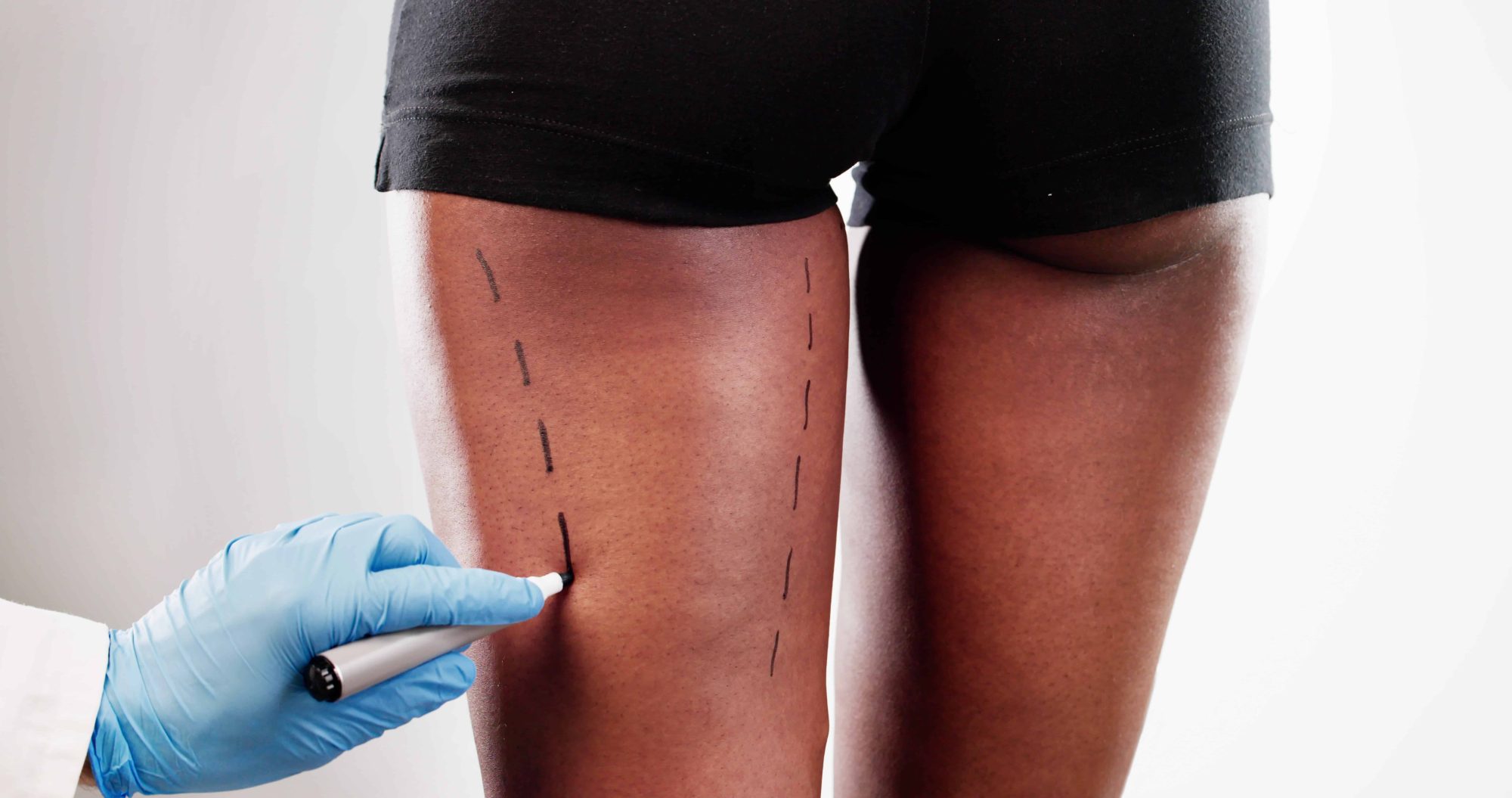
I’d like my thighs to look better – what are my options?
Plastic surgeons often hear from patients about improving the appearance of their thighs. This may be related to stubborn excess fat that isn’t responding well to exercise or loose skin that causes irritation and makes it harder for clothing to fit properly. This is especially common today, due to weight loss surgeries and medications such as semaglutides (GLPs).
Below, Brad Denney, M.D., with Mountain Brook Plastic Surgery discusses a few surgical options that can be tailored to the patient’s needs and goals. The procedures are listed from least invasive to most invasive, and not every procedure is right for every patient.
Liposuction
For patients who have excess fat but no loose skin, liposuction is an excellent option. Small incisions (cuts) are hidden in the groin area for the liposuction tubes. The procedure takes less than one hour, and it can be done without general anesthesia in some cases.
Laser liposuction
For patients with excess fat and mildly loose skin on their thighs, laser liposuction is an excellent option. The procedure is the same as standard liposuction, but laser technology is also used to help tighten the mildly loose skin. It takes about the same amount of time as standard liposuction and sometimes can be performed without general anesthesia.
Thigh-plasty (thigh lift)
For patients with moderate to severe loose skin, a thigh lift may be the ideal option. Unlike with liposuction or laser liposuction, a larger incision is required to remove the loose skin.
The length and placement of the incision depend on the severity and location of the loose skin. If the loose skin is limited to the upper thigh, the incision often can be hidden in the groin area. If loose skin is present on most of the inner thigh, an incision from the groin to the knee is often required. This is common among patients who lost a large amount of weight through bariatric surgery or medications.
What can I expect for my recovery?
The procedures discussed above are very safe and have low complication rates, but all surgeries carry some degree of risk. The most common complications are highlighted below.
Liposuction and laser liposuction
The most common minor complication is contour deformity. This is where the liposuction is not smoothly distributed between one area of the thigh to another. This issue often resolves with time or massage. In rare but severe cases, fat grafting or repeat liposuction may be required.
Thigh lift
The most common minor complication is an unsightly scar. The final appearance of the scar is not apparent until six months to one year after surgery. Immediately after surgery, the plastic surgeon will provide instructions on scar care, which can help reduce the appearance. Despite these efforts, a scar revision procedure may be necessary in less than 10% of cases. This is most often the case when an incision is needed for the entire length of the inner thigh.
Patients should be aware that it may take up to 3-6 months for the swelling from the procedure to subside and for the final appearance of the thighs to “settle in”.
Patients recovering from any of the procedures listed above should not lift over five pounds for four weeks and must wear compression garments over their thighs for 4-6 weeks. Thigh lifts often require a drain, which is removed about one week after surgery.
What are my next steps?
Our team of board-certified plastic surgeons would love to speak with you and walk you through a consultation specifically devoted to your aesthetic goals. Please call 205-871-4440 today to schedule your initial consultation session with our team.